

4 December 2025
Artist Highlight - Daheng Liu
Interview and Review
Daheng Liu (b. 1993, Yantai, Shandong), graduated from the National Academy of Chinese Theatre Arts, Royal Academy of Fine Arts Antwerp, and London College of Fashion. He is currently pursuing a PhD in Curating at the University of Essex.
Major group exhibitions include: 'London College of Fashion Graduate Showcase', OXO Tower Wharf (2019); 'TO BE ANTWERP', Leonhard’s Gallery (2020); 'Beyond the Anthropocene - An Exhibition of Future Science+Art', Garry Culture Center (2021); 'Post-Anthropocene: Future Science Exhibition', Kuntaijiarui Art Center (2021); 'Variations - Anren Biennale', Da Jiang Zhi Men Culture Center (2021); 'Everyday Recursion', Shanxi Contemporary Art Museum; 'New Media Art Exhibition', He Art Museum (2024).
Major awards include UK Lumen Prize nomination; Excellence Award of the Beijing Character Modeling Competition; and selection for the World of Wearable Art Competition.



ARTIST INTERVIEW
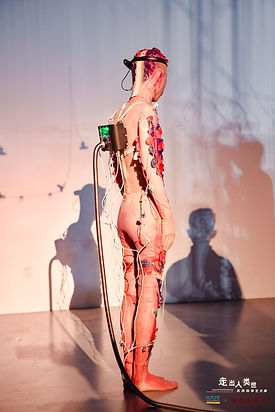
1. In “Flesh Reflection,” you employ sensors and thermochromic materials to create a feedback loop between the wearer’s physiology and a mechanised installation. How did you calibrate that dialogue so that subtle emotional and physical changes trigger distinct audiovisual responses?
"Flesh Reflection" was about carefully tuning the interface between body and machine so that the wearer's smallest shifts-heartbeat, skin temperature-became amplified through light, sound, and motion. I worked closely with my collaborator, Yongjian Su, to calibrate the sensors. However, what fascinated me was less the precision and more the poetics of that feedback loop: the idea that a trembling hand or rising pulse could ripple outward into an environment, making visible the invisible. For me, this reveals something fundamental about the post-human body, not as a stable, autonomous entity, but as a hybrid, extended system always in negotiation with its surroundings.
2. “We Know Nothing About Water” stages an immersive cascade of shower curtains embroidered with bodily sounds. Could you talk us through the process of matching internal stethoscope recordings to water imagery?
With "We Know Nothing About Water," I wanted to collapse the boundaries between interior and exterior, between the body's wetness and the world's wetness. I recorded stethoscope sounds-heartbeats, bowel gurgles, breaths-and translated their rhythms into embroidered patterns on translucent shower curtains. These are layered against watery projections and ambient soundscapes to evoke the body as its oceanic system. The result is a strange intimacy: viewers find themselves surrounded by liquid metaphors for their internal tides, invited to listen, feel, and remember that we are never as solid or self-contained as we imagine.
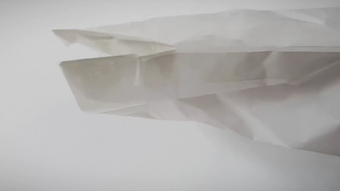
3. In “Breath,” the performer and wind-driven paper sculpture navigate a landscape of blankets and excavated ground. How do you choreograph the tension between human endurance and mechanical repetition to evoke both vulnerability and resilience?
In "Breath," the choreography is built around friction: the fragility of the human body struggling across uneven ground, mirrored by the relentless pulse of the paper installation. I think of it less as a formal dance and more as an endurance ritual duet of persistence. The blankets soften the excavation site but also mark it as a transitional space, a place of repair and exposure. By setting the performer and the machine into parallel motion, I wanted to evoke both the exhaustion and the stubborn resilience of moving through instability, both physically and politically.
4. Your work consistently foregrounds the porous boundary between organic flesh and synthetic extension. How does your background in costume design and performance inform your material choices, rubber, hose, sensor arrays, that collapse distinctions between body and apparatus?
My background in costume design taught me to think of the body not as a boundary but as a site of constant negotiation surface that absorbs, transforms, and extends. Materials like rubber tubing, sensor arrays, and thermochromic fabrics come from this sensibility: they are not "props" or "tools" but collaborators that blur the line between flesh and mechanism. When I select materials, I'm always asking: how can they participate in embodiment, how can they amplify the thresholds where skin becomes technology, or gesture becomes interface?
5. Drawing on queer theory and critical post-humanism, you interrogate how bodies are “defined, disciplined, and imagined.” Which theoretical texts or artists have most directly influenced your approach to embodiment-as-installation?
I've been deeply influenced by Judith Butler's notion of performativity, Donna Haraway's cyborg, and José Esteban Muñoz's queer futurity. These thinkers remind me that bodies are never just biological-they're social, political, and speculative. In the studio, I translate these ideas through tactility: using materials that are unstable or transitional, creating spaces that invite touch, friction, and immersion. I want viewers to feel theory not as an abstraction but as something that tingles on the skin, weighs on the chest, or brushes the edge of vision.
6. Across these three pieces, you create liminal zones where audience and artwork co-perceive. When visitors move through the shower-curtain cascade or wear the sensor suit, what kinds of encounter or self-reflection are you inviting?
Across all these works, I'm interested in making the audience part of the circuit-disrupting the passive gaze and inviting co-perception. When a visitor moves through the shower curtains or wears the sensor suit, they're not just looking at an artwork; they become part of its breathing, pulsing ecology. I hope that these encounters destabilize fixed hierarchies of form, gender, and spectatorship, opening up zones where bodies can be porous, playful, or unruly in ways they often aren't allowed to be in public space.
7. Your practice spans biotechnology, new media, and live performance. How do you manage collaboration with engineers, programmers, and performers, and what challenges arise when translating speculative theory into practical, multi-sensory environments?
Collaboration is central to my practice, and it's always an exercise in translation-bridging the language of code, choreography, engineering, and critical theory. One of the biggest challenges is holding onto the speculative or poetic vision when you're deep in the weeds of technical constraints. But I've learned that the most interesting moments often come from these frictions: the surprises when a sensor misfires or a performer improvises against a rigid system. That's where the work finds its aliveness.
8. Finally, you speak of “re-materializing consciousness” in your statement. How do you see the role of art in reclaiming or reframing the body’s “invisible flows of desire, memory, and affect,” especially in an ever-accelerating techno-cultural landscape?
When I speak of "re-materializing consciousness," I'm trying to resist the disembodiment that pervades so much of contemporary digital culture. I see art as a way of bringing the flows of desire, memory, and affect back into material encounter-into breath, touch, weight, and texture. Especially now, when acceleration and abstraction often push us out of our bodies, I think artists have a crucial role to play in reminding us what it means to live as fleshy, contingent beings moving through a volatile world.



BREATH AND THE MATERIAL POLITICS OF ENDURANCE
Review by Chih-Yang Chen, Art Director