

25 May 2026
Artist Highlight - Alejandra Hermida
Interview and Review
Alejandra is a Mexican artist based in London, working primarily with ceramics. Her background in product and interior design deeply informs her practice, shaping a strong interest in materiality, tactile surfaces, and the relationships between objects, space, and humans. Growing up in Mexico fostered a deep fascination with craft, which led her to pursue a Master’s degree in Ceramics at Central Saint Martins, University of the Arts London. She currently works there as a Graduate Teaching Assistant, specialising in clay 3d printing.


ARTIST INTERVIEW
1.Your works translate peeling walls and layered surfaces into ceramic form. What interests you about these fragile architectural traces, and how do you approach transforming something ephemeral and often overlooked into a permanent material like clay?
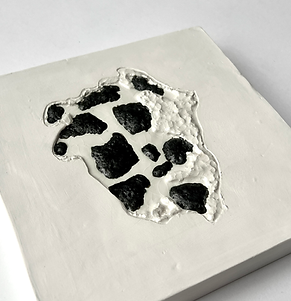
These spaces and walls have been witnesses to human existence. We inevitably leave our trace in the places we inhabit by transforming them; sometimes even into new spaces. An old church could become a restaurant, an abandoned warehouse could transform into a gallery space, architecture becomes an archive of change and time. By replicating peeling walls into a ceramic wall sculpture I’m highlighting human presence and its interaction with architectural structures, how they hold our stories, and how we take some of those places with us as well.
2. In this series, surfaces act as records of human presence. How do you decide which marks, cracks, or irregularities are preserved in the ceramic translation, and which are allowed to disappear in the process?
I aim to replicate the original peeling walls as closely as possible while acknowledging the influence of my own process. Despite this intention, the act of making inevitably introduces variation, and I embrace these differences as integral to the work. Rather than exact copies, the process transforms the original surfaces into something personal, the pieces become interpretations, shaped by both material and hand.
3. Several works are titled after specific locations or coordinates, such as México – London and 51.59760° N, 0.10988° O. How do these geographic references shape the narrative of the pieces, and what role does place play in the reading of the work?
The works titled with coordinates are a reinterpretation of peeling walls that exist in the real world; each title marks the exact place that inspired it. In contrast, in the pieces named as cities such as Mexico - London, I explore the architectural contrasts between my two homes: a volcanic rock wall in my house in Mexico and the botanical wallpaper of my first home in London. My background in product and interior design draws me to these subtle, site-specific details, highlighting how textures, materials and surfaces can capture memory, identity and the distinct character of a place.
4. Clay traditionally carries associations with permanence and historical memory. How does the use of earthenware allow you to rethink the idea of architectural memory and the passage of time?
By preserving peeling walls I aim to highlight how architecture evolves alongside human life. This observation began while visiting a restaurant in Oaxaca city, which had previously been a house. This prompted me to consider how many lives, and generations it had witnessed. The layered paint on its walls became a visible record of human interaction over time. Through clay, I ‘freeze’ these traces, rethinking architectural memory not as permanent, but as something continuously rewritten through use, transformation, and the passage of time.
5. Your practice embraces irregularity and unpredictability. Within this body of work, how do you negotiate control and chance during the making process, particularly when recreating textures that originate from real walls?
In this work, I balance control and chance by starting from specific visual references while allowing memory and material to reshape them. Certain elements, like volcanic rock textures or the wallpaper from my first home in London, aim for close accuracy. However, these pieces are rooted in memory, and memory itself is inherently unstable and transformative. The places we recall are already altered by our perception. Similarly, clay introduces its own unpredictability through process and firing. As a result, the final forms are not exact replicas but interpretations, where both human memory and material behavior reshape reality into something subjective, and personal.
6. Some pieces incorporate materials such as ceramic crayons, watercolours, or locally sourced clay. How do these material choices affect the way memory, place, and authorship are embedded within the work?
I incorporated London clay into the London-based piece so that the primary material directly reflects and honors the origin of that specific wall. When precise detail was required, such as recreating the wallpaper from my first home in London, I turned to watercolors and crayons for their immediacy and specificity. In contrast, to evoke the texture of volcanic rock, I relied on my own glaze that could replicate its depth and irregularity. Each material and process was chosen balancing accuracy with interpretation while remaining sensitive to the character and identity of the place.
7. The series reflects on migration and belonging. In what ways do the layered ceramic surfaces mirror the emotional or psychological experience of carrying fragments of multiple homes?
When we move from one place to another we look to make a new home out of our new environment. I wanted to use layers to represent how my original home is Mexico, but my current home is the UK. I would say when we migrate, it’s inevitable that we bring the previous places we lived in with us, they are part of our identity, part of our history and who we are. These places leave a trace on us, just as much as we leave a trace on the places we leave behind.
8. There is a tension between abstraction and documentation in these works: they resemble fragments of architecture yet also function as sculptural compositions. How important is recognisability to you when viewers encounter these surfaces?
Although documentation lies at the core of this body of work, the resulting surfaces can read as abstract compositions. I’m interested in that tension, where recognisability becomes a subtle element. These places are not landmarks or easily identifiable sites, they are hard to recognize. I focus on retaining key visual elements that suggest the identity of a place such as the outline of a peeled wall or specific colors, textures and materials. This allows the work to exist between abstraction and reference, inviting viewers to engage intuitively instead of identifying a precise location.



SURFACE, MEMORY, AND THE ARCHIVE OF WALLS
Review by Chih-Yang Chen, Art Director