

20 July 2026
Artist Highlight - Cheer Manlekha
Interview and Review
“I see myself as an artist, architect, designer, maker, illustrator, photographer, and writer using these roles to express my thoughts and emotions, to be vulnerable, to be true to myself. Together, they shape who I am and how I continue to grow.”
Based in London, Cheer Manlekha is originally from Thailand, yet shaped by many places she calls home. Through familiar, mundane everyday objects, she explores themes of impermanence and personal human experience. Cheer studied Industrial design at Central Saint Martins where she developed her approach involving natural elements, allowing its life cycle to guide the process while minimising human intervention to reflect cycles and transformation of all living things.



ARTIST INTERVIEW
1. The title Sati carries the meaning of remembering or bearing in mind. What are we being asked to remember through the chair?
What I hope people remember through “Sati” is the simple fact that we are alive. We spend so much of our lives rushing from one thing to the next that we rarely stop to acknowledge the present moment. The chair was made to invite you to pause, to sit down, breathe, and appreciate the fleeting beauty of life while we still can.
2. The chair is made from fallen pine wood. How did the fact that the tree had already fallen affect your relationship with the material?
The fallen tree gave me an even deeper respect for the material. I see it as something that spent its entire life standing strong in one place, witnessing the street, the people, and the passing of time, until nature itself decided that its time had come. Working with fallen wood felt like a way of continuing its life. By turning it into a chair, I hope to honour its life and preserve a small part of its legacy by allowing its life cycle to guide the process while minimising human intervention to reflect cycles of growth.
3. The uneven legs make the sitter partly responsible for the chair’s balance. Were you interested in making the body more conscious of itself?
Since the chair is intentionally uneven, it encourages people to utilize their own legs for support, preventing a forward fall. This recalls a meditation pose of the Buddha, where he props up his head with his hand. If he were to fall asleep, the hand would drop and awaken him, pulling him out of meditative state. In the same way, the need to stabilize oneself in this chair serves as a reminder to be mindful, stay present, to remain aware of our bodies, and to acknowledge that we are still alive and living in this very moment.
4. You describe the chair as something that will age, gather marks and eventually return to soil or ash. How do you understand the life of the object after it leaves your hands?
I don’t see the chair as complete when it leaves my hands. Its story continues through the people who use it and the marks it gathers over time. To me, those marks are evidence that the object has been lived with and cared for, not signs of damage but signs of life. Like us, the chair will age, change, and carry traces of its experiences. One day it may no longer function as a chair and eventually it will return to the earth. I find comfort in that. It is simply how things go, just like every life here on Earth.
5. The work deals with death, but it does not feel morbid. It feels tender, even calming. How did you arrive at that tone?
I love witnessing the change of seasons.
To me, it is one of the gentlest and most beautiful gifts that life offers. Death is not always something tragic. In many ways, it is what gives life meaning. If we were to live forever, perhaps nothing would feel truly precious. I hope to help people see the beauty in impermanence, to become a little more familiar with death and accept it as a natural part of life. Endings bring a new beginning and we will forever be part of it. And yet I can’t say I am at peace with loss. I still struggle to let go and that’s simply part of being human.
6. Your practice often allows natural cycles to guide the work. What does it mean for you to make with less control, rather than more?
I often say that I let natural cycles guide my work, but the truth is that I am quite a control freak. Perhaps working this way is my attempt to slowly learn how to let go. Greenwood is freshly cut and unseasoned, retains much of its natural moisture and will inevitably warp or crack as it dries. Rather than seeing this as flaws, I embrace them both technically and philosophically. In woodworking, greenwood can be used to advantage, as shrinking timber tightens joints without the need for glue. By accepting what I cannot control, I allow the material to become a collaborator in the making process.


THE CHAIR THAT KEEPS YOU AWAKE
Review by Sara Chyan, Curator
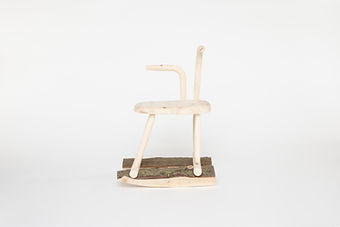
Cheer Manlekha makes a chair that unsettles one of furniture’s most basic promises: that once we sit down, the object will take over the work of holding us. Sati is deliberately uneven. The sitter has to keep their feet on the floor and remain aware of where their weight is moving. The adjustment is slight, but it changes sitting from a passive act into one that requires attention.
The title comes from the Buddhist idea of sati, associated with remembering and mindful awareness. Cheer does not try to communicate this through a calm appearance alone. She builds it into the chair’s use. The object interrupts the point at which we would normally stop noticing how we are sitting.
The chair itself is spare. A pale pine seat is supported above two bark covered rails, while two bent uprights rise to different heights. There is no conventional backrest to settle into. These uprights offer partial support, but they also give the chair an unusual posture. Seen from the side, it appears alert and slightly awkward, as though it is resisting the idea of complete comfort.
Cheer speaks about minimising human intervention, yet Sati is clearly not an untouched or loosely assembled object. The seat has been shaped, the joints carefully fitted and the instability deliberately designed. This contradiction is one of the more interesting parts of the work. Cheer’s role is not to withdraw from making, but to decide where her control should end.
The chair was made from green wood, which continues to dry after it has been worked. It may shrink, warp or crack over time. These changes are not surface effects added to suggest age. They belong to the behaviour of the material itself. The object can leave the studio, but it does not become fixed at that moment. Its appearance and structure will continue to develop through drying, use and contact with different bodies.
The fallen tree introduces another history. Cheer describes making the chair as a way of continuing its life, although I do not think that continuation is seamless. The tree has fallen, been cut apart and remade through skilled labour. Something has ended, even as another use has begun. The bark left on the two base rails makes this change particularly visible. Its rough surface sits directly beneath the pale worked timber, allowing the earlier material and the finished object to remain present together.
Cheer connects this process to mortality and to the eventual disappearance of the chair itself. With use, its surface will gather marks. At some point it may no longer function as furniture and could return to soil or ash. The idea might have felt overly comforting had Cheer presented herself as completely at peace with this cycle. Instead, she admits that she still struggles with loss and with letting go. That uncertainty prevents Sati from becoming a neat lesson about accepting death.
The uneven balance is partly informed by an image of the Buddha resting his head against one hand while meditating. If he begins to fall asleep, the hand drops and wakes him. Cheer translates this idea into the mechanics of the chair rather than illustrating it directly. The sitter is not asked to understand a symbol before using the work. Awareness begins through the body.
For me, the most convincing part of Sati is not the symbolism of the fallen tree or even the chair’s future decay. It is the ordinary moment when the sitter feels their weight shift and places their feet more firmly on the floor. The chair does not demand a dramatic performance. It asks for a correction that may be almost invisible to anyone else. Through that small movement, mindfulness becomes something physical rather than simply an idea.
Sati offers rest, but never quite enough for the body to forget that it is there.