

13 July 2026
Artist Highlight - Daosheng Han
Interview and Review
Daosheng Han (b. 2001, Shandong) is an artist based in Guangzhou and London. He holds a BA in Oil Painting from the Guangzhou Academy of Fine Arts and is pursuing an MA at Chelsea College of Arts. Investigating the intricate dynamics between individuals and communities, his practice spans painting, installation, archives, and moving image. Han received the Xu Qinsong Creation Award Silver Prize (2024) and has exhibited widely internationally, including solo show at the Guangdong Contemporary Art Center,group show at Crypt Gallery. His work addresses individual survival and societal structures.


ARTIST INTERVIEW
1. LC**W** uses a car licence plate, an object that is designed to identify but is rarely looked at closely. What made you want to bring it into the space of painting?
A license plate is essentially an identification tool serving the traffic control system; although ubiquitous, it is rarely examined closely. Bringing it into the space of painting strips away its utilitarian functionality. More importantly, it creates an opportunity for viewers to cast an emotional gaze upon a symbol otherwise saturated with systemic discipline.
2. A licence plate carries information, control and public visibility. What changes when it is removed from the street and placed on canvas?
Its role shifts from an administrative tool to a visual signifier. It is transformed from a shackle that binds individual identity into a visual object that is, in turn, scrutinized and interrogated by the individual.
3. Your work combines the language of tracking with vivid colour and humour. How do you use wit without reducing the seriousness of the subject?
The quantification and discipline imposed on individuals by urban systems are incredibly cold, oppressive, and even brutal. If I were to paint them in a similarly cold, somber, and monochromatic palette, I would merely be replicating the system's own sense of oppression. Instead, highly saturated colors are deployed to capture and arrest the viewer's gaze; I intend to obscure the gravity of the underlying theme, burying it deep beneath the vibrant surface.
4. The blurred informational imagery suggests that identity is present, but not fully readable. Is this about protection, erasure, or both?
I see it as both protection and deprivation. For the beneficiaries, the blurred image acts as a shield to conceal or shroud their identity. However, for the uninitiated—or even for non-human entities—it functions more like a form of deprivation, forcing them to submit to a human-centric power structure.
5. You speak about the city as a matrix in which identities are coded and measured. How does the individual survive within that structure?
This has always been a central motif in my work: individual survival within such communities is inherently awkward and precarious. There is a constant friction and entanglement between personal desires and the compliance required for sheer survival.
6. There is a feeling of closeness and alienation in the work at the same time. Does that contradiction reflect your experience of urban life?
Yes, absolutely, and it is often triggered by very minute details—such as hostile architecture on the streets or the constriction of space around transport infrastructure. These everyday encounters constantly manifest as an invasion into one’s personal, informational space.
7. Your work seems to ask whether public systems become strange only when we stop accepting them as normal. What do you hope viewers notice after seeing LC**W**?
I hope it prompts viewers to confront the realization that they are already living in a fundamentally domesticated and disciplined state.



WHAT REMAINS READABLE
Review by Sara Chyan, Curator
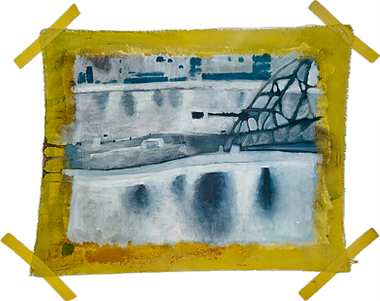
Daosheng Han’s LC**W** brings together a painted river view and a damaged car licence plate. The plate has been fixed over the centre of the image, partly covering the boat and the space around it. Its surface is scratched, bent and worn at the edges. A yellow-green blur hides the registration number, although the outline of the original characters remains visible beneath it.
Daosheng is interested in the systems that make people and their movements identifiable. On the road, a licence plate is designed to be read quickly and without much thought. Once it is removed from a vehicle and placed on a painting, that automatic response changes. I found myself looking at its dents, tape and dealer information before trying to read the number. The object begins to reveal the history of its use, rather than simply performing its administrative function.
The act of concealment is deliberately awkward. The blur does not make the plate disappear. Instead, it draws attention to the exact place where information has been withheld. The title behaves in the same way, replacing some characters with asterisks while leaving enough for us to recognise the format. Privacy is presented as partial rather than secure.
Yellow spreads beyond the licence plate and around the edge of the canvas. It appears in painted areas, masking tape and the plate itself. Daosheng uses the colour to attract attention, but it also belongs to warning signs, road markings and systems of public instruction. The surface feels bright and immediate without becoming cheerful.
Behind the plate, the painting is loose and quiet. A pale boat crosses the water, while the bridge is reduced to a dark framework. The image gives a sense of movement through the city, but the central identifier blocks part of the view. This makes the licence plate feel less like an object added to a painting and more like something interrupting our access to it.
The symbolism is direct. A licence plate, a censored number and an urban setting quickly establish the subject of identification and control. The work becomes more interesting through its untidy physical details. Tape remains visible at the edges, the plate is heavily marked and its lower strip still carries the name of a motorcycle dealer. These traces prevent it from becoming a clean symbol. It belonged to a particular vehicle and passed through commercial and administrative systems before entering the artwork.
Daosheng describes contemporary urban life as a condition in which participation and restriction are difficult to separate. The same systems that allow people to move through a city also record, classify and regulate that movement. LC**W** does not offer an escape from those systems. Instead, it takes one of their most ordinary objects and makes it difficult to overlook.