

27 April 2026
Artist Highlight - Elizabeth Benson
Interview and Review
Elizabeth Benson is a material-led sculptural artist based in North Wales. She works with ecological colour, natural fibres and controlled tension to create pieces shaped by slow, geological pressure. Introduced to natural dyeing at a young age, she works with an embodied understanding of ecological colour and material behaviour. Her practice grows from walking, gathering and plant-dyeing, allowing each piece to hold the palette and atmospheric weight of its landscape. She teaches natural dyeing and brushmaking and has shown in a showcase at Ruthin Craft Centre and a regional sculpture trail.


ARTIST INTERVIEW
1. Surface Tension describes fibre as behaving like terrain. What draws you to this comparison between textile material and geological processes?
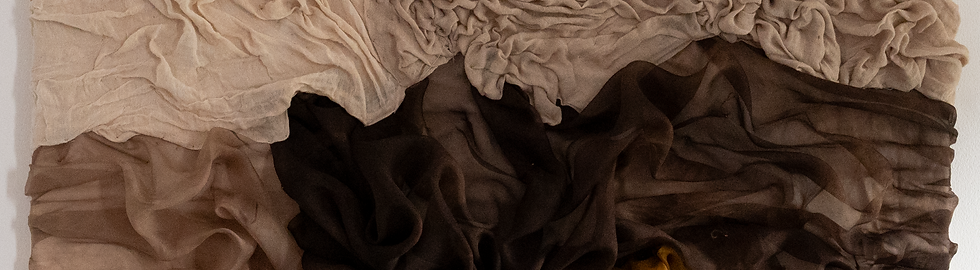
I’m drawn to how cloth behaves under pressure. When it’s stretched, folded, or held in place, it forms ridges, basins, and disruptions that feel very close to geological structures. It’s something I noticed through working with the fabric, rather than set out to imitate. Both systems are shaped over time by force. The fabrics I use already carry a history of making, so the surface becomes a meeting point between those earlier processes and the physical conditions I introduce.
2. Your work begins with walking and gathering natural dye materials. How does the landscape directly shape the colour palette of the piece?
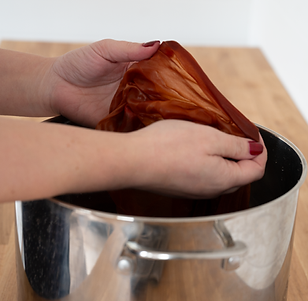
The landscape and the palette are inevitably intertwined. The colour comes from what is available, alder cones, walnut husks, rhubarb root, each shifting depending on season, weather, and where they’re gathered. I don’t try to stabilise that; the variation is what makes each piece specific to a place and moment. At the same time, I’m working onto dressmaking fabrics, materials already shaped by other hands and processes, so the colour sits across both landscape and manufacture, holding traces of both.
3. The surface appears calm at first, yet closer inspection reveals layers of tension and compression. How do you construct this sense of pressure within the textile structure?
The pressure comes from how the fabric is handled. It’s anchored, pulled, and allowed to respond unevenly. Muslin tends to relax and flatten, while organza holds more body to the folds, so there’s a constant negotiation between them. What looks calm at a distance is actually holding a lot of tension. The structure carries that quietly, rather than presenting it overtly.
4. Natural dyes from walnut husks, alder cones, and rhubarb root carry specific ecological histories. How important is the origin of these materials within the meaning of the work?
The origins of the materials are important to me. Where possible, I work site-specifically, gathering dye materials from a centralised location so the fabric holds a trace of that place at a particular moment in time. These materials don’t produce fixed colours, they shift depending on how they’re processed, the fibre they meet, and the conditions they move through. I’m interested in allowing those differences to remain. Within The Invisible Made Visible, colour becomes more than aesthetic; it acts as evidence of origin and handling.
5. The work sits between textile and sculpture. At what point does a textile surface become a sculptural form in your practice?
The work begins flat, with one cloth layered over another. It shifts as the folds are held in place through stitching, and the surface starts to lift. I often raise the piece as I work, allowing gravity to act on the fabric and influence how it settles. That’s the point where it crosses into something sculptural, when the material is no longer just lying on a surface, but actively holding form through tension, weight, and resistance.
6. Within The Invisible Made Visible, your piece reveals slow transformations embedded in material processes. What aspects of time and labour do you hope viewers recognise when encountering the work?
The work holds a sequence of processes, gathering, dyeing, handling, tensioning, and stitching, alongside the earlier labour embedded in the manufacture of the fabrics themselves. The surface is built gradually through hours of small, hand-sewn stitches, each placed in response to how the material is behaving. I’m interested in how those layers of labour remain present but not immediately visible. The piece doesn’t announce them, but it carries them. Over time, that accumulation begins to surface.


PRESSURE, COLOUR, AND THE MEMORY OF LAND
Review by Chih-Yang Chen, Art Director