

4 May 2026
Artist Highlight - Harshena Kapoor
Interview and Review
Harshena Kapoor is an artist and designer working across ceramics, glass, and digital fabrication. Her 3D-printed work explores her dialogical relationship with clay, investigating how somatosensory experience shifts when moving from hand-making to technological processes through a neurodivergent lens. This focus on embodied creativity is supported by a diverse educational background: a BA in Drawing & Painting from OCAD University, a year of architectural studies at the University of Toronto, and an MA in Ceramics & Glass from the Royal College of Art. Together, these experiences inform a practice grounded in material inquiry, spatial sensitivity, and expanded understandings of neurodivergent engagement with craft.


ARTIST INTERVIEW
1. 3D printing is often associated with precision and control. What interests you about introducing unpredictability and material agency into this technological process?
Although 3D printing is often associated with precision and control, my practice embraces a lack of control through experimental object-making, which focuses on thinking through the act of making. By working intuitively, I create opportunities for unexpected inspiration and embrace the element of chance. Transitioning from a digital representation to a 3D-printed ceramic object requires me to let go of a certain level of control during the creation process. This allows a natural co-emergence of form and ideas, foregrounding the material’s dynamic properties and the traces of movement inherent in making.
2. Early collapses and technical failures became part of your learning process. How have these moments of instability informed the final language of the work?
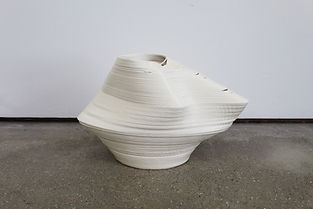
My early experiments failed when I didn't use a support structure or an air-drying gun. I learned to engage with the material intuitively and to find a balance between forcing and guiding the clay. I experimented with printing at a slower speed, allowing the material to be more independent, and explored the decision to either intervene with an external support system or to let the material transform and express itself on its own terms. As a result, the final work embraces visible lines, variation, and the imprint of the technique, reflecting the journey, interaction, and history of making.
3. In the Cocoons series, organic forms emerge from a digital 3D-printing process. How do you translate intuitive gestures into the structured language of digital fabrication?
My design process begins with an intuitive 2D sketch, a free-flowing organic gesture. I then bring these lines to life in three dimensions through digital modelling. Although the imprint of hand use takes on a different form, I still relied on a similar process to that of hand-building. By using both digital and manual sketching, I enter a flow state that supports form development and allows ideas to emerge spontaneously. This intuitive design process maintains my connection to the object even in a digital realm, enabling forms to carry traces of gesture and movement within the structured framework of 3D printing.
4. You approach making through a neurodivergent perspective on perception and sensory engagement. How does this influence the way you experience working with clay through digital tools?
I have noticed that my making process relies heavily on intuition, muscle memory, and sensory feedback when engaging in experimental object-making. Although the imprint of hand use takes a different approach, I still leaned on a similar process to hand-building. By entering a flow state, I can pay closer attention to the sensory experiences during my creative process. This awareness allows me to listen to the material as an active collaborator, fostering a more dynamic relationship rather than simply manipulating it. Incorporating this approach helps normalize instability and enhances my engagement, creating a more natural and reactive relationship with the material.



CONTROL, COLLAPSE, AND MATERIAL NEGOTIATION
Review by Chih-Yang Chen, Art Director