

13 April 2026
Artist Highlight - Kai Hsuan Chang (London Craft Week 2026)
Interview and Review
Kai-Hsuan Chang is a Paiwan Indigenous artist from Taiwan, currently based in London and completing an MA Fine Art at Chelsea College of Arts, University of the Arts London. Working across sculpture, installation, moving image, and performance, his practice explores material boundaries and Indigenous memory. Through handcrafted processes, he re-tribalizes transformed landscapes, examining how energy infrastructures reshape land and memory. His work has been exhibited across international independent and institutional platforms, and continues to develop through research-led and process-based experimentation.




ARTIST INTERVIEW
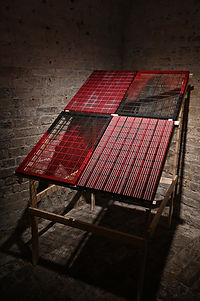
1. SOLAR- translates large-scale solar panel infrastructures into handcrafted forms. What drew you to reinterpret these industrial structures at a human scale?
Because I work away from home, I rarely return. On one visit, I found the entire landscape had changed—it was shocking and difficult to accept. For my family, the loss of a familiar environment was deeply unsettling. This experience led me to transform these cold solar infrastructures into forms that reconnect with objects and landscapes we once recognised and lived with.
2. The work uses wood, rope, and dye rather than technological materials. How do these handcrafted materials reshape the meaning of energy infrastructure?
Rather than reassigning meaning to infrastructure, I see this work as an act of reactivating cultural memory and asserting presence. By constructing the piece entirely with traditional handcrafted materials, I intentionally distance it from technological function. In doing so, the solar form is stripped of its utility and re-situated as a site where memory, material, and cultural identity can re-emerge.
3. The installation reflects on landscapes altered by solar panel fields in your homeland. How do these forms carry personal and cultural memory?
This land once held many traces of Indigenous life—from my grandmother to my mother, our community was deeply rooted there. Ceremonies such as weddings, where we danced in traditional dress, remain among my most vivid memories. Through the work, I seek to layer these embodied memories onto the surface of solar structures, allowing personal and cultural histories to reappear and coexist with imposed forms.
4. Through handcrafted processes, you aim to “re-tribalize” transformed landscapes. What does this idea mean within the context of this work?
“Re-tribalization” reflects a reversal of historical positioning. Indigenous peoples in Taiwan have long been shaped by successive colonialisms, absorbing external cultures through religion, rituals, and everyday life. Rather than remaining in a passive position, I ask: what if we become the agents who redefine these structures? Through this work, re-tribalization becomes a way to shift from marginality to agency—reclaiming the right to interpret, transform, and inhabit the landscape on our own terms.
5. Within The Invisible Made Visible , the work reveals hidden relationships between infrastructure, land, and identity. What aspects of these relationships do you hope viewers reflect on when encountering SOLAR-?
On one level, the work continues and affirms Indigenous cultural presence. At the same time, while renewable energy is increasingly seen as necessary and progressive, I want to question what remains unseen behind it—what is displaced or lost. The work also reflects an emotional response to the sudden transformation of one’s homeland, capturing the disorientation and complexity of witnessing a familiar landscape radically altered.


LAND, MEMORY, AND THE AFTERIMAGE OF INFRASTRUCTURE
Review by Chih-Yang Chen, Art Director