

30 June 2026
Artist Highlight - Lena Heinrich
Interview and Review
Lena Heinrich is a Berlin-based multidisciplinary artist, designer, and environmental engineer. She trained in heritage millinery before studying water and environmental engineering in the UK, building an international career in the water sector. Alongside, she developed her craft and design practice. In 2019, she founded a design studio in Johannesburg, shifting to material-led work. After returning to Europe, she completed a further Master of Advanced Studies in craftsmanship-focused product design at ECAL, Lausanne. Her work appears in publications such as Vogue Italia, Le Temps, and House&Leisure. In 2026, she received the Ruskin Mill Trust Prize for functional art.




ARTIST INTERVIEW
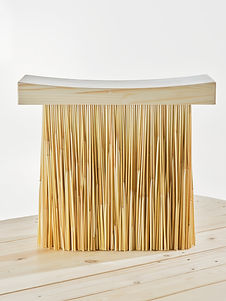
1. Taxonomy of a Straw Bundle begins with the humble straw bundle. What drew you to investigate this overlooked agricultural material as the foundation of the work?
The work began with a focus on hyperlocal materials and what is readily available on our doorstep. This led me to grasses. Straw is abundant, yet today largely reduced to low-value use despite its long history and embedded vernacular knowledge. I became interested in traditional techniques working with straw and how this can be translated into contemporary design. Beginning with a straw bundle allowed me to work from something ordinary and test how far it could be pushed beyond its assumed role.
2. Elements such as the basal ends and nodes are usually discarded or hidden. What interested you about bringing these overlooked parts to the forefront?
Even in traditional craft techniques, these parts are usually removed as they are considered unsightly and to create consistency. In working with the material more closely, I found these parts however carry both structural strength and a distinct visual beauty. Rather than correcting them, I chose to work with them and highlight these parts. This shifts the process from controlling the material to responding to it, allowing its inherent natural variation to define the outcome.
3. The restrained pine seat references vernacular farmhouse furniture. How does this historical reference contribute to the narrative of the object?
The reference grounds the piece in its origin. Straw is tied to rural life and its furniture traditions, so it felt important not to abstract them too far. The form draws from what is already there, rather than importing external references. By keeping that connection, the work becomes a continuation rather than a departure - a contemporary expression that remains rooted in its material and cultural context.
4. The piece is constructed using only rye straw, pine wood, and fish glue, making it fully compostable. How important is material responsibility within your design decisions?
It is central. Alongside my training in craft and design, I have worked as an environmental engineer for over a decade. This informs how I approach materials, not only in terms of performance or look, but in terms of lifecycle. Using straw, pine, and fish glue allows the piece to remain fully compostable. Material decisions are not an afterthought but the starting point, shaping both the process and final design.
5. Your practice treats craft as a living and evolving discipline. How does this work reinterpret traditional techniques within a contemporary context?
The work builds on techniques such as bundling (after harvest) and thatching, where strength comes from aggregation rather than individual fibres. I take this logic and apply it in a different context - adjusting scale, application, and form. Traditional knowledge of how to handle, process and bind materials remains central, but it is extended through experimentation for contemporary furniture design. In this way, the technique is not preserved for museumification, but adapted to remain relevant and alive.
6. Within The Invisible Made Visible, your work reveals hidden structural knowledge within natural materials. What do you hope viewers begin to notice differently about everyday materials after encountering this piece?
I hope it draws attention to what is usually overlooked. Straw carries centuries of vernacular knowledge, yet today it is largely dismissed - with only a few practitioners maintaining those traditions. By bringing its qualities to the forefront, the work highlights the depth of understanding embedded in everyday materials on our doorstep. It raises the question of what else we are not seeing, and what knowledge is being lost through standardisation and distance from material sources.


WHAT WE CHOOSE NOT TO SEE
Review by Chih-Yang Chen, Art Director