

13 May 2024
Artist Highlight - Lindsay Yin
Interview and Review
Lindsay Yin, native from China, graduated from the University of Miami with a Bachelor's Degree in Film, and then studied Illustration at the University for the Creative Arts in the UK for her Master's Degree, where she worked in various forms of oil painting and digital art. As a rising artist of Generation Z, her diverse background gives her works a global perspective. Her works are mostly based on the theme of linking the past, present and future, focusing on the changes in people's lives and the problems they need to face under the rapid development of technology. The colour blue and various forms of water are recurring elements in her works, giving a sense of solitude and serenity.



ARTIST INTERVIEW
1. Your artistic journey has taken you from studying film in the United States to pursuing a Master's in Illustration in the UK. How has this diverse background shaped your artistic perspective and the themes you explore in your work?
At first, my diverse cultural background brought me a lot of confusion. What you conceive in one cultural context may not be applicable in another, so I encountered obstacles on the path to finding my true "self." However, I later realized that in art creation, this is a unique advantage because your perspective is broader. You unconsciously seek commonalities between different cultures and focus on what concerns all of humanity, considering the potential impact on all of humanity in the future. Because no country can exist independently of others; it's about balance, not binary opposition. Global climate and environmental changes, technological advancements – it's hard to definitively say what's purely good or bad; it depends on one's perspective. That's why my works often present open-ended themes without clear viewpoints because I deeply understand the limitations of my own knowledge, and I'm willing to share the space for thought and imagination with the audience.
2. Your art often centres on the theme of linking the past, present, and future, particularly focusing on the impact of rapid technological development. Could you elaborate on the specific changes in people's lives and the challenges they face that inspire your work?
I often draw inspiration from classical works. For example, the fountain in the pixelated world was inspired by Jan Gossaert's"Adam and Eve" created in 1520. The fountain in this context carries many metaphors. In Genesis, God separated darkness, water, and land in the first three days of creating the world. The fountain in the Garden of Eden introduces water, a natural element, into a human-made structure, forming a cycle. It represents the evolution of human civilization and nurturing. Building magnificent fountains also symbolizes hedonism and humanity's pursuit of beauty. The screens we face, like pixelated fountains, shower us with pixels of information and pleasure.
3. The color blue and various forms of water are recurring elements in your art, evoking a sense of solitude and serenity. How do these elements contribute to the narratives in your pieces, and what emotions or messages are you hoping to convey?
Water is an element that appears in almost every one of my works. It is colorless and tasteless. Shades of blue and green, in fact, represent a form of water that I personally admire. It often appears in the ocean under the sunlight or in a clean swimming pool. Life originates from the ocean, and it holds many unknowns and aspirations for us. At the same time, water has the power to engulf everything – tides, waves, floods. With this longing and awe, I can explore "water" in various forms and themes.
4. You've mentioned the increasing blurring of boundaries between the real and digital worlds. Can you provide a detailed review of how this blurring is depicted in your artwork and what it signifies to you?
The pixelated world is actually a very interesting subject. Pixels are the basic units for image display, and the more pixels per unit area, the higher the resolution, making the displayed image closer to reality. However, when you enlarge these images enough, you can gradually discover their distortion. This series of works simulates different visual experiences brought about by different pixel counts per unit area.
Once, I didn't bring any electronic devices to a café near my home. I noticed that everyone except me was looking at their phones or computers. I quietly sipped my coffee, observed the expressions of each person, experienced the afternoon sunlight, and saw a butterfly resting on a flower petal. The material world we live in is composed of molecules, and molecules are made up of atoms. The perceived reality of this world is actually due to the small size of molecules and atoms. Could our world, the one we live in, also be a pixelated world? I found that I spend an average of 5-7 hours a day facing electronic screens. We gather information, work, study, and entertain ourselves on these screens, experiencing joy and sorrow. The pixelated world has long become a part of our real world. So, based on these thoughts, I created this series of works.
5. Your statement also touches on environmental issues, specifically the release of pollutants like nuclear wastewater into the sea. How does this environmental concern translate into your art, and what role do you believe art plays in raising awareness about such issues?
For example, in this series, the inspiration for the mutant fish and the sorrowful mermaid comes from recent events, such as the discharge of nuclear wastewater into the sea. Nuclear pollutants may have been in the ocean for a long time. The ocean is the cradle of life, and nuclear contamination is bound to have some impact on the ecological balance of the sea. The extent of this impact is uncertain. However, if nuclear-contaminated water is not discharged into the sea but stored in a country with frequent tectonic plate movement, what kind of hidden dangers might it pose, how much cost is required to make this water harmless, and where will that cost come from? In my work, the mermaid can only come from the ocean to the land, but she has not yet evolved legs adapted to terrestrial life, so she can only weep on the rocks.
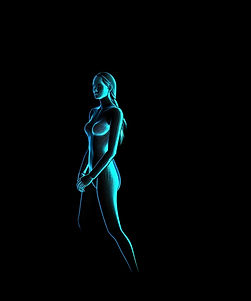
The recurring female elements in this series were initially intended to represent my digital avatar. I integrated modeling and generative art into this creative process. If you look closely, you'll notice that "they" all look very similar, yet each one is subtly different, symbolizing the multiple possibilities of the digital future.


BLUE BETWEEN WORLDS
Review by Chih-Yang Chen, Art Director