

17 June 2026
Artist Highlight - Seungjoo Mun
Interview and Review
Seungjoo Mun is a Korean-born, UK-based jewellery artist working at the intersection of sculptural form and wearable object. A persistent curiosity about hidden structures drives her practice: the internal logic of how things are made, broken, and transformed, and what these processes expose about the nature of objects themselves.
A graduate of Birmingham City University's School of Jewellery and current Artist in Residence (2025–2026), her work has been recognised internationally, including as a Finalist in the Progold 3D DfAM Contest 2026. Through material experimentation, Mun redefines jewellery as a structural inquiry made wearable.


ARTIST INTERVIEW
1. The Spine series draws on the body’s internal structure as a conceptual model. What led you to use the spine as a framework for these jewellery pieces?
The Spine series began with a personal observation: I found the remnants left during making more meaningful than the finished surface. This prompted a question: where does essence truly reside? Whilst considering this, I naturally thought of the human spine. It enables form and movement yet remains almost entirely unrecognised beneath the skin. I wanted to work with this logic of invisible yet essential structure within jewellery, and the spine became both a conceptual framework and a structural model for the series.
2. Your work focuses on remnants and fragments from the making process. What interests you about elevating these overlooked elements into the final work?
I don't see fragments and remnants as by-products. They carry traces of decisions, adjustments, and hesitations that occur during making. Typically, these elements are removed to achieve a polished finish, but I feel the essence of the work remains within them. Rather than using the physical fragments themselves, I adopt their role as hidden yet essential carriers of process, and make that the structural principle of the work. What interests me is shifting attention from surface to the underlying logic that sustains it. In this way, the pieces reveal not only the completed form but the act of making itself.
3. The forms appear both skeletal and architectural. How does your sculptural background influence the structural language of the pieces?
My background in sculpture means I approach jewellery less as decorative objects and more as small sculptures with internal logic. I consider balance, structure, and spatial relationships in the same way I would with sculpture. This thinking shaped the formal language of the Spine series. The forms emerge from structural considerations rather than ornamental ones, which is why they read as both skeletal and architectural. For me, jewellery is a small sculpture experienced close to the body.
4. Within The Invisible Made Visible, your work foregrounds the hidden frameworks that support form. What aspects of structure or process do you hope viewers become aware of when encountering these pieces?
As an observer, I'm drawn to the aesthetic qualities of art, even when they serve no practical purpose. But as a maker, I'm drawn to something more fundamental. What holds the most important role yet receives the least attention? This question led to the Spine collection, which asks viewers to look beyond visible form toward what quietly supports it. I hope it invites people to consider where essence might reside, not in what we immediately see. If someone becomes curious about the relationship between form and structure, then the work is doing what I hoped.


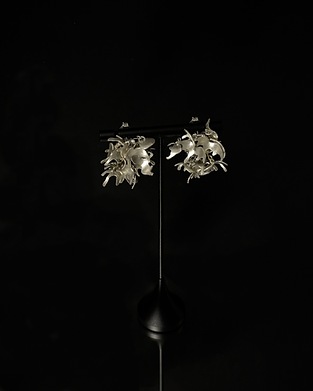

WHAT STAYS HIDDEN
Review by Chih-Yang Chen, Art Director