

22 March 2026
Artist Highlight - Severina Seidl
Interview and Review
Severina Seidl is a German, award-winning artist and hand embroiderer who pushes the boundaries between embroidery and fine art. She studied fashion design in Germany before pursuing a degree in hand embroidery at the Royal School of Needlework in London. Her graduate piece, Maleficium, was recognised by the Worshipful Company of Needlemakers for Most Innovative Stitch and by Tex+ Trustees for Technical Excellence, and won first place in the Hand & Lock Prize in the Student Textile Art category. Her work has been exhibited at Heimtextil in Frankfurt and at the Knit & Stitch shows.


ARTIST INTERVIEW
1. Chronostasis captures a suspended moment in time through the image of butterflies resting briefly before disappearing. What drew you to this idea of time paused within the work?
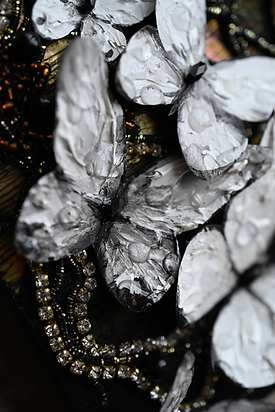
Creating is a very material-led process for me, I enjoy making art for the sake of creating. In my practice, I like to experiment with different materials and combine them in organic and unexpected ways. Each deliberate decision becomes a small moment within the process. In Chronostasis, these accumulated choices come together as moments of making that feel frozen in time, guided largely by intuition. The idea of butterflies emerged slowly, aiming to combine realism and abstraction. Their brief moment of rest suggests a pause within the otherwise continuous movement and change of both nature and the act of making.
2. Your work combines embroidery with materials such as brass, resin, and beads. How do these contrasting materials influence the visual and tactile language of the composition?
The contrasting materials create tension within the composition, introducing varied dimensions and surface qualities. Brass, resin, beads, and embroidery interact to produce complex visual and tactile structures. This layering adds depth and richness, while allowing the surface to develop organically. For me, it is about finding the right materials and techniques to convey the emotions I wish to express. The materials should enhance the work rather than overwhelm it. Through gradual layering and the slow accumulation of texture, the piece develops an atmospheric and slightly raw quality, while still maintaining a sense of balance and apparent effortlessness.
3. Butterflies often symbolise transformation and ephemerality. How do these associations resonate within the context of this work?
Butterflies emphasise the dreamlike quality of Chronostasis: they are usually in constant motion, and it is rare to see them resting long enough to be observed closely. Their stillness within the work heightens the overall surreal and ephemeral atmosphere of the piece. In contrast, the base references scorched earth—something grounded and heavy, imperfect, rough, and marked by damage—suggesting a more brutal form of transformation. Together, these elements reflect different dimensions of change: one delicate and fleeting, the other forceful and enduring.
4. Your practice frequently merges traditional embroidery with sculptural elements. How does Chronostasis challenge the conventional boundaries of textile art?
I am driven by a desire to translate my unpredictable mark-making into embroidery, transforming this traditionally controlled medium into something more organic and sculptural. In Chronostasis, I incorporate materials such as metal and amber to achieve this. The butterflies are constructed from paper, acrylic paint, and resin, rather than fabric and thread. A heat-tempered brass sheet forms the central base of the work—a material rarely associated with hand embroidery. Techniques such as beading and couching are present, but primarily serve to enrich the surface texture, challenging conventional perceptions of what textile art can be.
5. Within The Invisible Made Visible, the work foregrounds the quiet labour embedded in hand-making. What aspects of time and process do you hope viewers become aware of when encountering the piece?
Hand embroidery is a time-consuming practice that requires patience and repetition. Each stitch holds a moment of labour, making the process itself visible within the finished work. The piece embodies time, frozen into a single object, shaped through testing, experimentation, and continual exploration of materials. It is not a process that can be hurried. I often think of artists as weavers of time—art makes time tangible and visible to others. Through physical and emotional effort, this labour becomes embedded in the work, allowing viewers to sense the time, effort, and presence of the maker.



SUSPENDED TIME AND MATERIAL TENSION
Review by Chih-Yang Chen, Art Director