

3 July 2026
Artist Highlight - Xinchen Li
Interview and Review
Xinchen Li is a jewellery artist and sculptor from China, currently based in the United States. Evolving from small-scale wearables to immersive installations, her work navigates memory, migration, and cultural identity. She has exhibited internationally at the Museum of Arts and Design in New York and Munich Jewelry Week. Her accolades include the Women's Jewelry Association June Herman Scholarship, The ALL Prize, and winning the Mixed Media Category at the 38th Materials: Hard + Soft International Contemporary Craft Competition. Her work is featured in Vogue China, Create! Magazine, and the Jewelry and Metalsmithing Survey.


ARTIST INTERVIEW
1. The Neck Piece is constructed line by line using a 3D printing pen. How does this drawing-in-space process shape the structure and character of the work?
Building line-by-line turns the 3D pen into a tool for drawing directly in three dimensions. The piece grows organically, allowing decisions about density and contour to happen in the moment. Afterward, I refined the form with a heat gun. Ultimately, this process ensures every filament serves as both a structural member and a visible mark of creation.
2. The transparent PLA material gives the piece a sense of weightlessness. What interests you about creating forms that appear present yet almost immaterial?
I am fascinated by how translucence stages presence without mass. Transparent PLA lets light pass through, casting shadows that function as a second surface, which makes the work both object and echo. This duality mirrors the nature of memory itself: feeling simultaneously solid yet entirely insubstantial. By withholding opacity, I invite viewers to complete the work with their attention. It asks them to notice how true presence can be felt through light, contour, and fragile structure, rather than physical bulk.
3. The layered lines resemble thread, breath, or scaffolding. How do these visual references connect to the themes of memory and displacement in your practice?
Thread, breath, and scaffolding represent different ways of holding personal history. Thread implies mending and domestic craft; breath is a transient trace of living presence; scaffolding provides provisional support for movement and passage. Together, they illustrate how memory and the experience of displacement are sustained by delicate systems that simultaneously protect and expose us. My work maps these modes of holding, visually demonstrating how continuity and vulnerability coexist within our shifting identities.
4. The slow, repetitive making process records the gestures of the hand. How important is the visibility of labour within the final form?
The visibility of labor is essential to my practice. Repetition, small repairs, and uneven rhythms are tangible evidence of time and care. By keeping these elements visible, the act of making becomes central to the work's meaning. These traces resist an anonymous, mass-produced aesthetic, instead archiving attention and persistence. When labor is legible, the object holds a narrative. It allows viewers to read the process as a record of endurance, choices, and repair, rather than viewing it as a neutral, polished commodity.
5. The work sits between jewellery, sculpture, and spatial drawing. How does this hybrid quality influence the way the piece is experienced on the body?
On the body, the piece exists as a complete, structured form. Off the body, it transforms into a suspended spatial drawing or an intimate sculpture. This hybridity invites entirely different modes of attention. It foregrounds personal intimacy while simultaneously opening the work up to public display.
6. Silver foil and silver elements appear within the delicate PLA structure. How do these contrasting materials affect the perception of the work?
Metal punctuates the translucent PLA with reflection and weight. The silver elements act as focal points, suggesting concepts of repair, heirloom value. This material contrast clarifies scale and gesture by providing the fragile filaments with moments of solid resistance. Furthermore, the reflective surfaces change how light interacts with the piece, producing bright highlights and deeper shadows that beautifully complicate the relationship between delicate fragility and lasting endurance.
7. Your practice often explores inherited craft languages through contemporary technology. How does the 3D printing pen allow you to bridge these two approaches?
Because the 3D pen is handheld and slow, it preserves the stitch-like rhythm and deliberate decision-making of traditional domestic crafts. However, the material logic of PLA permits larger scales, suspension, and structural experiments that would be impossible with thread alone. This tool keeps the hand central to the process while offering a completely new vocabulary for form and space. Ultimately, it creates a meaningful continuity with inherited craft languages rather than simply replacing them with contemporary tech.

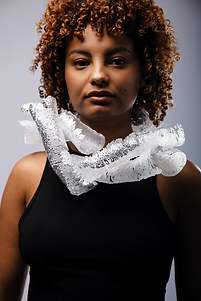

A STRUCTURE HELD BY BREATH
Review by Chih-Yang Chen, Art Director