

29 April 2026
Artist Highlight - Yuze Pan
Interview and Review
Yuze Pan (b. 2001, Heilongjiang) graduated from the Metal Craft and Jewelry Studio at the Central Academy of Fine Arts and is currently pursuing an MA in Jewellery & Metal at the Royal College of Art, London. His practice focuses on applied arts, exploring the properties of metal materials and their extended meanings. His work centres on boundaries, binary relations, and spatial transformation. Rooted in observations of his surrounding environment, he investigates potential connections between cultures, between people and objects, and between events. He draws on this interwoven state of making—together with a sensitive perception of the environment and an ability to synthesise abstractions—to translate lived experiences into works with a distinctive aesthetic language. Awards: 2026 GCDC.


ARTIST INTERVIEW
1. The brooch series Silver & Aluminium brings together handcrafted silver and precisely machined aluminium. What interests you about this dialogue between traditional craft and industrial production?
The question of traditional craft and industrial production has always been present, but the dialogue between them is not always harmonious. From my perspective, the important thing is to find the possibilities within both and make use of them in a way that supports the work.
2. Many of the forms are derived from equipment structures and moments encountered during making. How do these fleeting observations translate into the final compositions?
These sources of inspiration are actually very interesting to me. I have always been drawn to well-designed tools, and during the making process, whenever I come across a moment or structure that feels visually compelling, I sketch it down. Over time, these observations gradually accumulate and begin to form a visual language of their own.
3. The construction details of the brooches are intentionally visible. How does revealing these structural elements shape the way the pieces are read?
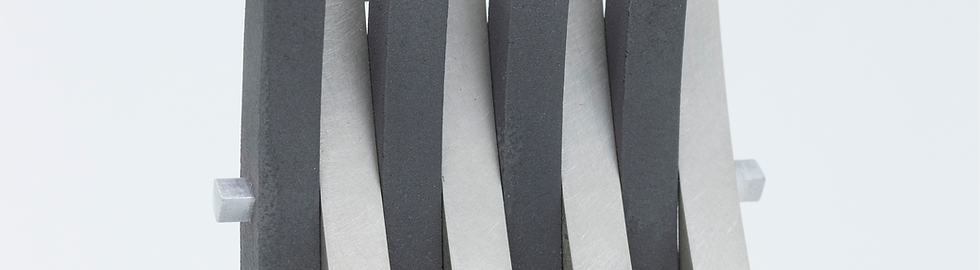
These particular structural details appear mainly in the connecting parts. What I want to suggest is that the artist is like this linking structure: someone who is able, through practice, to bring together and integrate elements that would otherwise remain unrelated.
4. Silver and aluminium carry distinct historical and technological associations. How do these material contrasts contribute to the conceptual language of the work?
Yes, I wanted this body of work to convey the atmosphere of the working environment. That is why the forms and structures are influenced by and imitate shapes found in the studio.
5. The series explores the relationship between heritage craft and contemporary production technologies. How do you negotiate this balance during the making process?
I would not describe it as a strict balance. For me, the relationship between them is simply one of coexistence. The question of which side should take up more space does not really matter, so during the making process I did not try to deliberately control or measure that balance.
6. Within The Invisible Made Visible, the work foregrounds processes that normally remain hidden behind finished objects. What aspects of making do you hope viewers become more aware of when encountering these brooches?
During the making process, there are certain dynamic moments that usually remain unseen. In these works, alongside forms derived from tools, I also tried to express some of those fleeting actions and moments of movement. That is the aspect I especially hope viewers will become more aware of.


STRUCTURE, CONNECTION, AND MOMENTS OF MAKING
Review by Chih-Yang Chen, Art Director